Literature discovery
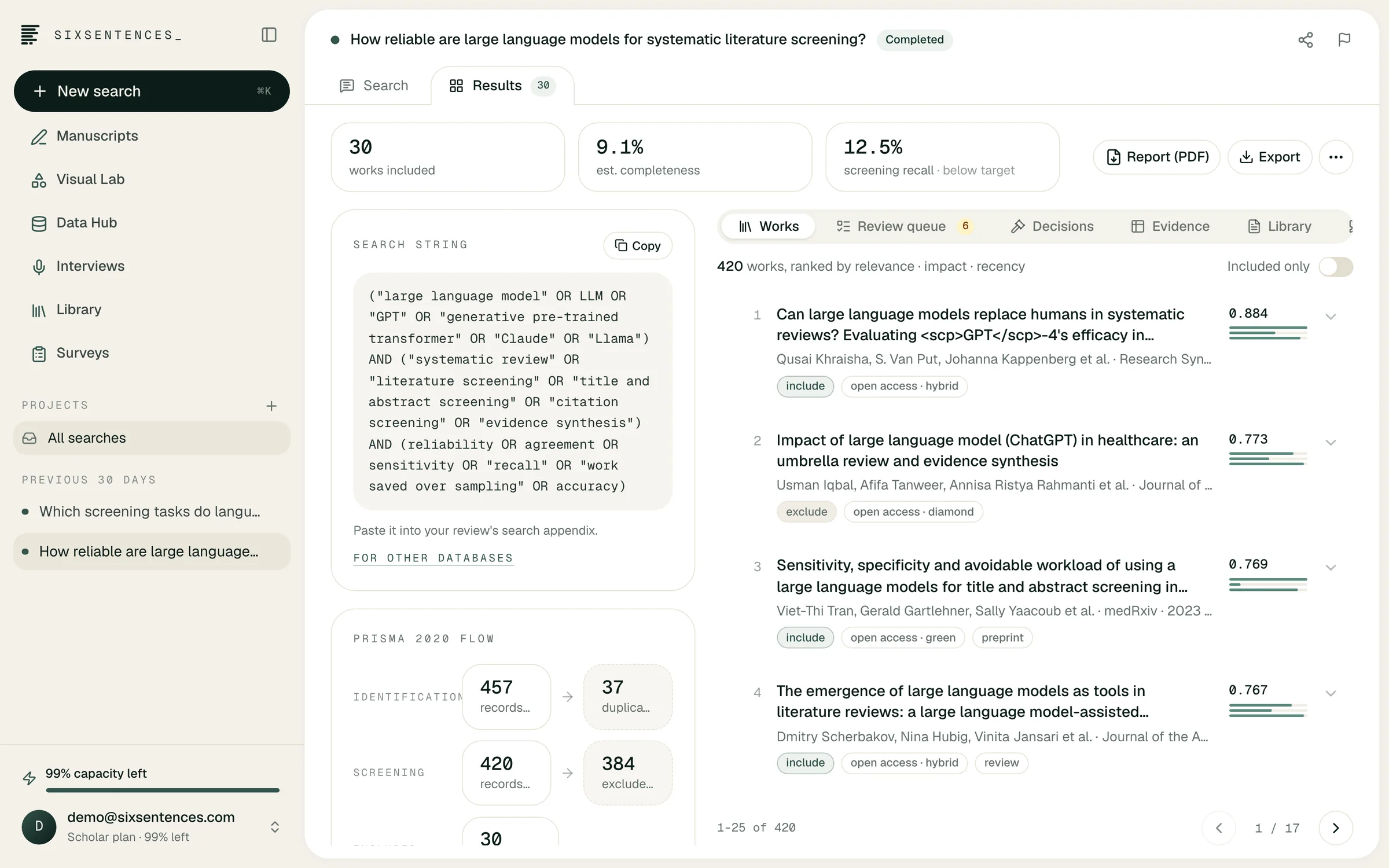
SixSentences_ combines scholarly metadata, the live web, known papers and uploaded sources in one literature search where every result keeps its origin and status.
In plain terms
- 01
Start with a question
Describe the topic in plain language, then inspect the concepts, search routes and candidate works used to broaden the search.
- 02
Combine discovery routes
Use scholarly metadata, web search, citation relationships, seed papers and your own imports without flattening them into one unexplained list.
- 03
Open the original evidence
Keep publication metadata, source links and available full text beside the result so relevance can be checked against the paper itself.
01 / 04
Frame the question
02 / 04
Expand and retrieve
03 / 04
Check coverage
04 / 04
Read and reuse
Method and boundaries
01 / 02
A natural-language question can reveal useful concepts, synonyms and adjacent terminology. It can also hide ambiguity. SixSentences_ therefore keeps the question, generated search routes and returned records visible instead of presenting a single ranked list as a complete literature base.
Coverage depends on the field, index, language, date range, document type and access conditions. A systematic search may still require subject databases, librarian input, hand searching and database exports that are outside any one product.
- Question-led and keyword-led discovery
- OpenAlex scholarly metadata and live-web search
- Seed papers, citation discovery and known-work checks
- Source URLs, metadata and retrieval provenance retained
02 / 02
A plausible title is not evidence. Before a record supports a claim, confirm that the work exists, that its metadata identifies the correct version and that the cited passage says what the claim requires.
Full text is available only when it is openly accessible, supplied by the researcher or otherwise lawfully available. SixSentences_ does not bypass publisher access controls and does not turn unavailable content into a verified source.
Literature discovery
01Which scholarly source does the search use?
The workspace can use OpenAlex scholarly metadata and the live web, together with seed papers, imported records and sources you add. Coverage varies by field and route.
02Does AI literature search replace subject databases?
No. Discipline-specific databases, institutional access and librarian-designed queries may still be necessary, especially when completeness is a review requirement.
03Can SixSentences_ fetch every paper as a PDF?
No. Full text can be attached when it is openly available, supplied by you or otherwise lawfully accessible. Publisher and repository access controls remain in force.
Literature discovery